
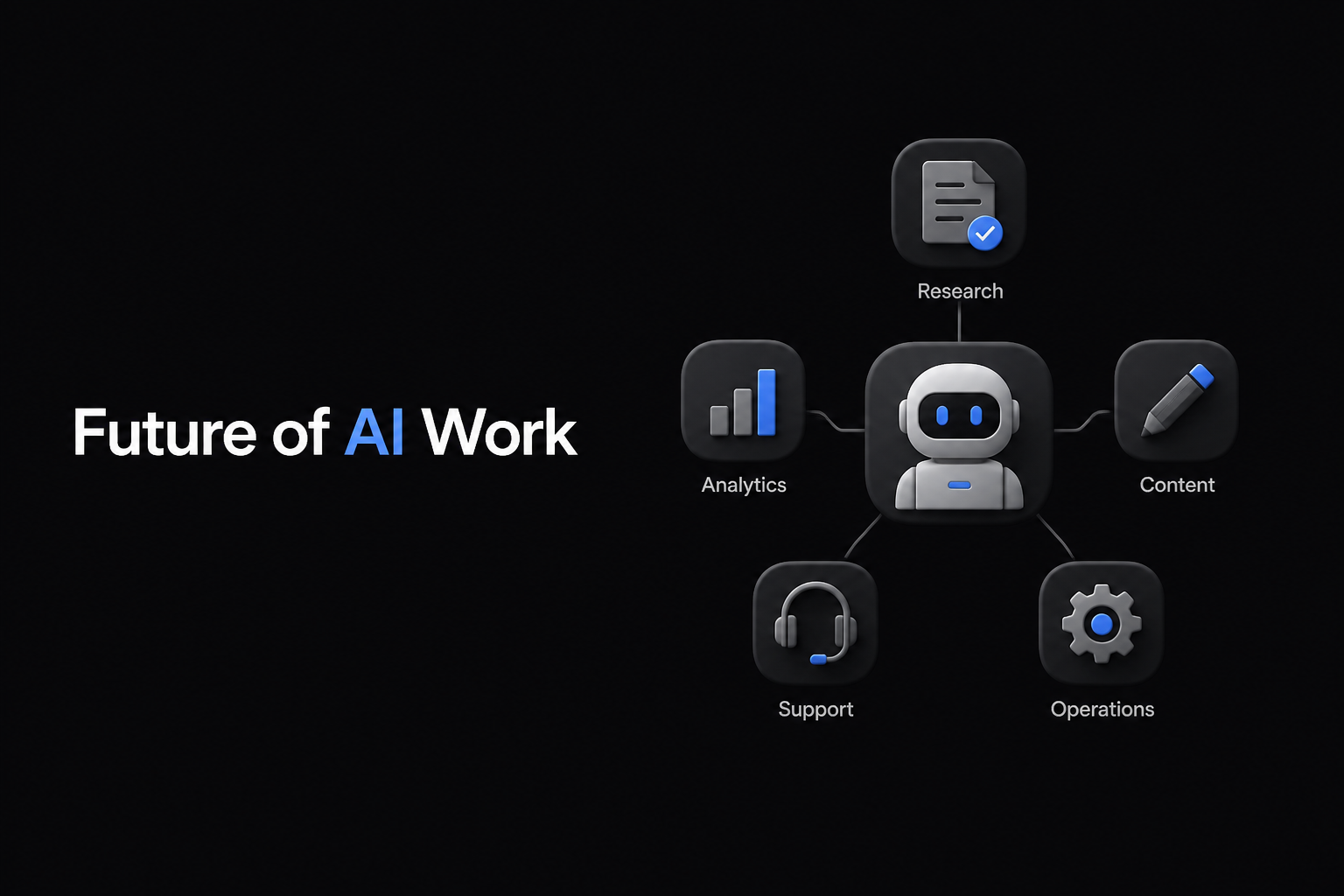
Future of AI Work: What AI Employees Will Actually Do in 2026
The future of AI is often portrayed as a sweeping revolution replacing human jobs entirely, but the reality of AI employees in 2026 will be far more nuanced. As AI work evolves, AI employees will take on specific, complementary roles that enhance human productivity rather than just automate tasks. This article explores the realistic roles AI employees will fill by 2026, how AI work will reshape workplaces, and what marketing teams should expect when integrating AI future tools.
Key Takeaways
- AI employees in 2026 will specialize in augmentation, data analysis, content generation, and workflow automation.
- Effective AI work depends on human-AI collaboration, not replacement.
- 2026 work tools will embed AI deeply into daily marketing and content workflows.
- Companies must plan AI adoption carefully to maximize benefits and avoid common pitfalls.
- AI future roles will require new skills in managing and integrating AI employees.
- Generating data-driven content variations for campaigns.
- Analyzing customer behavior patterns at scale.
- Automating repetitive approval and scheduling tasks.
- Train teams on effective AI work practices.
- Define clear roles for AI and human employees.
- Maintain transparency and control over AI outputs.
- Use AI tools that allow human approval before publishing.
- AI literacy to understand AI capabilities and limits.
- Workflow design to integrate AI tools effectively.
- Quality control to review and refine AI-generated work.
- Collaboration skills to balance AI suggestions with human judgment.
- AI employees in 2026 will specialize in focused roles that augment human teams.
- Collaboration between AI and humans is essential to maintain quality and creativity.
- New integrated work AI tools will embed AI deeply into marketing workflows.
- Careful planning and training are critical for successful AI adoption.
- Marketing teams should start building AI literacy and explore AI workspaces like DIMA to get ahead.
AI Employees Will Specialize Rather Than Generalize
By 2026, AI employees won’t be general-purpose workers but experts in focused roles. For example, in marketing, AI will excel at tasks like:
This specialization means AI employees handle high-volume, detail-oriented work, freeing human employees for strategy and creativity. Unlike broad AI myths, these AI workers will not replace humans but increase overall team capacity.
Human-AI Collaboration Will Define Work AI
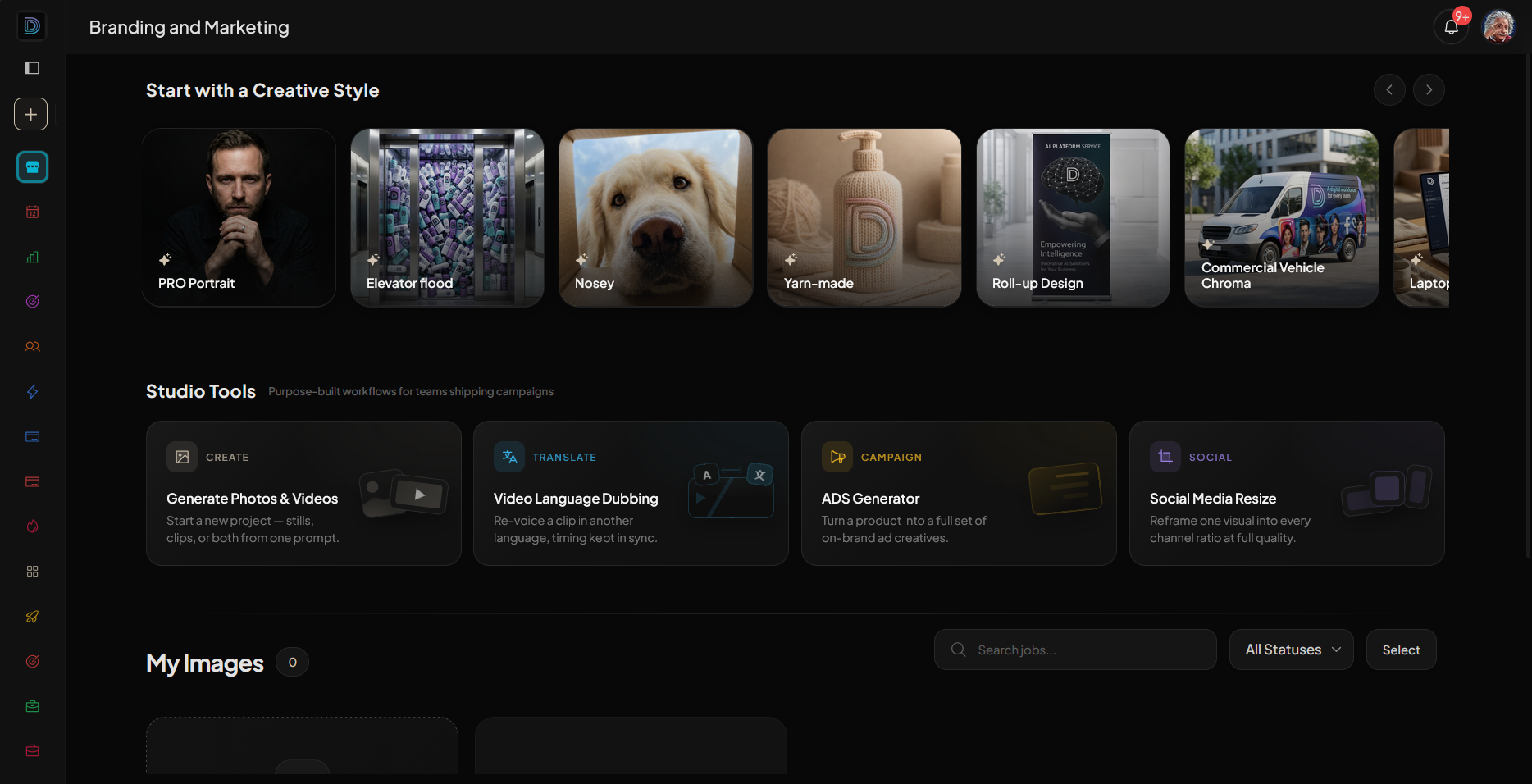
The future of AI work hinges on collaboration. AI employees will provide suggestions, generate drafts, or automate routine jobs, but humans will remain the final decision-makers. This hybrid model ensures quality control and creativity. For instance, marketing teams using AI workspaces like DIMA AI Media Studio can let AI handle initial content drafts while humans tweak and approve output, combining speed with oversight.
2026 Work Tools Embed AI Seamlessly Into Daily Operations
The AI future will bring integrated tools that blend AI employees into existing workflows. Instead of standalone AI apps, brands will use AI-powered workspaces that combine content creation, data insights, and automation. This reduces tool sprawl and makes AI work more manageable. For example, DIMA’s workspace unifies AI branding and marketing, enabling teams to run campaigns faster with fewer manual steps.
| Feature | Traditional Tools | 2026 AI Work Tools (e.g., DIMA) |
|---|---|---|
| Workflow Integration | Fragmented, manual handoffs | Seamless AI-human collaboration |
| Tool Sprawl | Multiple disconnected apps | Single workspace with multi-model AI capabilities |
| Content Creation Speed | Slow, human-dependent | Fast, AI-augmented with human approval |
Companies Must Plan AI Adoption Strategically
Studies show many organizations stumble by focusing solely on technology rather than process and culture. To succeed with AI employees in 2026, companies should:
These steps prevent common problems like workflow breakdowns or loss of creative quality. DIMA’s platform supports these best practices by enabling controlled AI work and approval workflows.
New Skills Needed to Manage AI Employees and Work AI
The rise of AI employees means skill shifts for marketing professionals. Key future skills include:
Organizations investing in training for these skills will unlock the full potential of AI future tools.
FAQ
What exactly are AI employees in the context of 2026 work tools?
AI employees are AI-powered agents or models embedded in business workflows that perform specialized tasks such as content generation, data analysis, or automation with human oversight.
Will AI employees replace human jobs entirely by 2026?
No, the trend is toward augmentation rather than replacement. AI employees handle volume and repetitive tasks, while humans focus on creativity, strategic decisions, and quality control.
How can marketing teams prepare for AI employees?
Teams should adopt AI workspaces like DIMA that support collaboration, train staff on AI tools, and establish clear approval workflows to balance AI speed with human creativity.
What are the biggest risks of adopting AI employees without proper planning?
Risks include workflow disruptions, loss of content quality, tool sprawl, and resistance from staff. Strategic planning and controlled adoption minimize these issues.
Are there examples of AI employees already in use today?
Yes, AI-powered content platforms, data analytics bots, and workflow automation agents are early forms of AI employees shaping the AI future.
Conclusion
Start shaping your future of AI work today with a free trial of DIMA’s AI workspace—empower your team to work smarter with AI employees.
Explore DIMA AI workspace
 DIMA
DIMA