


How to Actually Measure AI ROI: The 2026 Business Owner's Reality Check
Author: Alex Mercer Role: Head of AI Strategy at DIMA AI Published: February 8, 2026 Modified: February 8, 2026 Category: AI Strategy & ROI Reading Time: 13 minutes Tags: AI ROI, AI Implementation, Business AI Adoption, AI Cost Analysis, AI Measurement, Small Business AI, AI Success Metrics
The $40 Billion Question Nobody Can Answer
Your company just spent $2,000 on AI tools last month. Was it worth it?
If you paused before answering, you're not alone. Despite enterprises investing $30-40 billion in generative AI, only 5% can demonstrate measurable business value at scale. The problem isn't that AI doesn't work—it's that most businesses are flying blind.
Here's the uncomfortable truth: Early AI pilots in 2023 reported 31% returns. By 2025, as projects scaled, ROI dropped to 7%—below most companies' cost of capital hurdle rate. Only 25% of AI initiatives deliver expected ROI according to CEOs.
But there's a bright spot. The top-performing companies—the ones actually making AI work—achieve 18% ROI consistently. The difference? They measure differently.
This guide shows you exactly how they do it.
Why Traditional ROI Measurement Fails for AI
Before we fix the problem, let's understand why standard business cases don't work for AI tools.
The Capital Investment Model Trap
Traditional capital budgeting assumes you buy a tangible asset (machinery, software license) that depreciates predictably over time. AI doesn't fit this model because:
- It's process optimization, not asset deployment – You're not buying a thing; you're changing how work happens
- Benefits are distributed and incremental – Time saved across 40 people doing 20 different tasks
- Value compounds over time – AI gets smarter with usage; traditional assets depreciate
- Costs are variable and unpredictable – Token usage, fine-tuning, and integration costs fluctuate
> "Most organizations report localized business impact rather than enterprise-wide transformation. This requires more granular ROI measurement approaches focused on operational metrics." > — Controllers Council, 2026

The Missing Baseline Problem
The single biggest measurement mistake businesses make is failing to establish a baseline before implementing AI.
Example: Email Response Time
- Without baseline: "Our AI support tool is working great!"
- With baseline: "Response time dropped from 8 minutes to 45 seconds—a 89% improvement saving 7.5 minutes per ticket. At 200 tickets/week × $35/hour, that's $4,375/month in labor savings."
One is a feeling. The other is proof.
The 5-Dimension AI ROI Framework
Successful companies don't measure AI ROI—they measure five distinct types of value. Here's how to track each one:
1. Time Savings (The Easiest Win)
Time saved is the most immediate and measurable form of AI value.
How to Measure:
- Pick 3-5 common tasks your team does repeatedly (customer emails, document summaries, report generation)
- Time them for one week before AI implementation
- Track the same tasks for two weeks after implementation
- Calculate the difference
Real-World Example: Legal Contract Review
| Metric | Before AI | After AI | Impact | |--------|-----------|----------|--------| | Average review time | 45 minutes | 8 minutes | 82% faster | | Reviews per week | 24 | 24 | — | | Labor cost per review | $85 | $15 | $70 saved | | Weekly savings | — | — | $1,680 | | Annual value | — | — | $87,360 |
Formula:
Time saved per task × tasks per period × hourly rate = $ Value
2. Error Reduction (The Hidden Multiplier)
Errors don't just waste time—they destroy trust, create rework, and damage relationships.
What to Track:
- Data entry errors (typos, wrong fields, duplicate entries)
- Missed follow-ups or forgotten tasks
- Compliance violations or policy breaches
- Customer complaints related to mistakes
Real Example: Accounting Firm Data Entry
An accounting firm implemented AI-assisted data entry and tracked errors over 90 days:
- Before AI: 3.2% error rate (19 errors per 600 entries/month)
- After AI: 0.4% error rate (2-3 errors per 600 entries)
- Rework cost per error: ~$45 (research, correction, verification)
- Monthly savings: 16 errors × $45 = $720
- Annual value: $8,640 + improved client satisfaction

3. Capacity Expansion (Doing More Without Hiring)
The question isn't "Can AI replace humans?" It's "Can AI let your existing team handle 2x the volume?"
How to Measure:
Track throughput metrics before and after AI:
- Support tickets resolved per agent
- Content pieces published per marketer
- Proposals generated per salesperson
- Invoices processed per accountant
Real Example: Marketing Agency Content Production
A 12-person marketing agency implemented AI writing assistants:
| Metric | Before AI | After AI | Change | |--------|-----------|----------|--------| | Blog posts/month | 24 | 42 | +75% | | Social posts/month | 160 | 280 | +75% | | New hires needed | 2 ($120k) | 0 | $120k saved | | Team capacity | 100% | 175% | +75% output |
Key insight:
- They didn't cut staff. They doubled output with the same team, allowing them to take on 4 new clients without hiring.
Formula:
(New output ÷ Old output - 1) × 100 = Capacity increase %
4. Revenue Acceleration (The Growth Metric)
Some AI implementations don't just save costs—they directly generate revenue.
Revenue-Impacting AI Use Cases:
- Personalized outreach that converts faster
- Product recommendations that increase cart value
- Dynamic pricing that optimizes margins
- Lead qualification that focuses sales on high-intent prospects
- Content generation that increases organic traffic
Real Example: E-commerce Personalization
Coffee Beanery implemented AI-powered customer journey personalization:
- Before: $420,000 quarterly online revenue
- After: $541,800 quarterly online revenue (+29%)
- AI cost: $850/month ($2,550/quarter)
- Net quarterly gain: $121,800 - $2,550 = $119,250
- ROI: (119,250 ÷ 2,550) × 100 = 4,676% quarterly ROI
Real Example: B2B Sales Outreach
A SaaS company used AI to personalize 1,200 outbound emails:
- Before AI: 2.3% reply rate, 0.6% conversion
- After AI: 8.7% reply rate, 2.1% conversion
- New customers from campaign: 25
- Average customer value: $8,400 annually
- Campaign revenue: $210,000
- AI + labor cost: $4,200
- ROI: 4,900%

5. Quality and Consistency (The Compounding Asset)
AI's ability to maintain consistent quality creates long-term value that's harder to quantify but strategically critical.
What to Track:
- Brand voice consistency across content
- Policy compliance rates
- Customer satisfaction scores
- Audit findings and compliance violations
- Training time for new employees (with better documentation)
Real Example: Customer Support Consistency
A 200-person company implemented AI-assisted support responses:
| Metric | Q1 (Before) | Q4 (After) | Impact | |--------|-------------|------------|--------| | CSAT Score | 78% | 91% | +13 points | | Policy violations | 12/quarter | 2/quarter | -83% | | Escalations | 34/quarter | 11/quarter | -68% | | Agent training time | 6 weeks | 2.5 weeks | -58% |
While harder to assign a dollar value, the 13-point CSAT improvement prevented an estimated 15-20 customer cancellations worth $180,000 in annual recurring revenue.
The Real Total Cost of AI (What Nobody Tells You)
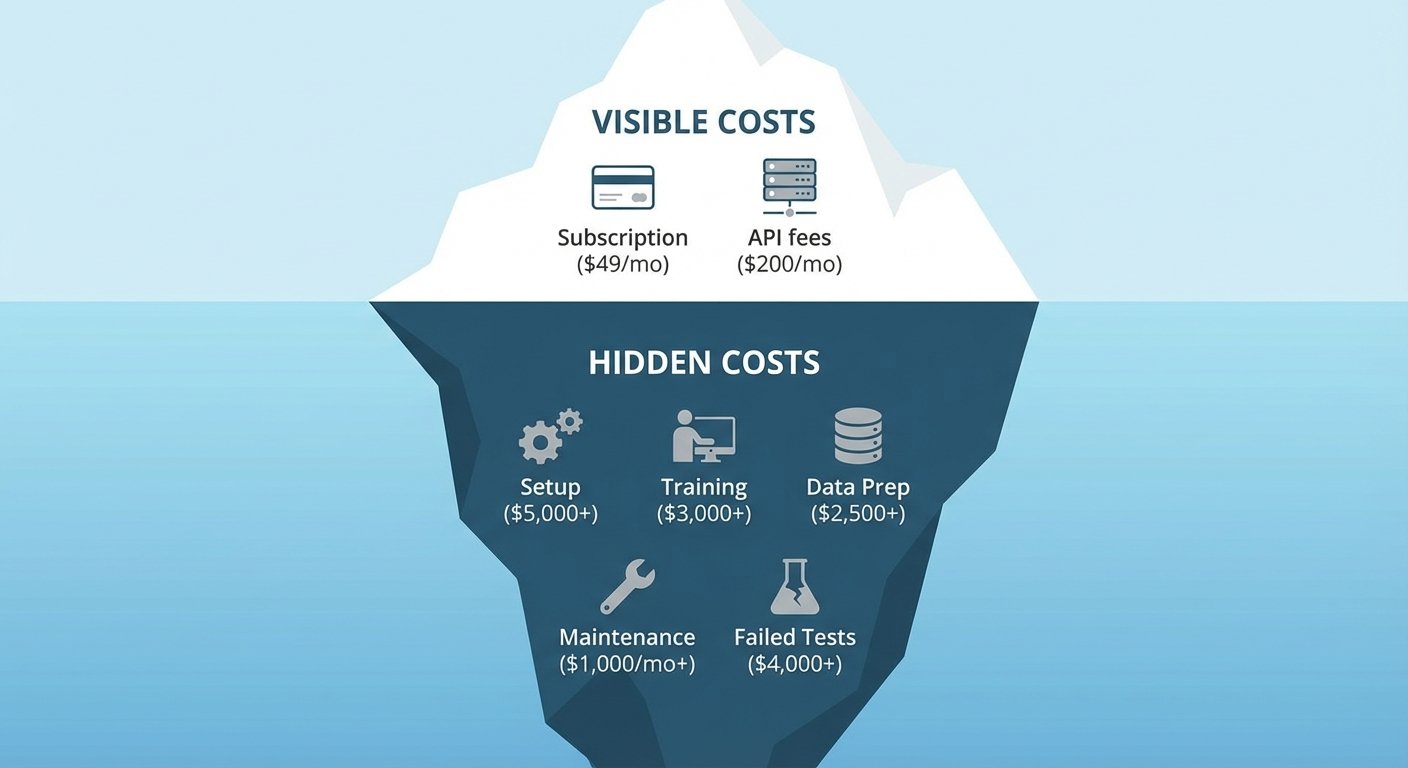
Most businesses drastically underestimate AI costs. Here's what you're actually paying:
Visible Costs
- Subscription fees: $20-200/user/month
- API/token usage: $50-5,000/month (highly variable)
- Integrations and connectors: $200-2,000 one-time
Hidden Costs (The Real Killers)
- Setup and configuration: 20-60 hours ($500-$20,000 depending on complexity)
- Training and change management: 5-10 hours per employee ($2,000-$10,000 for a 20-person team)
- Data preparation and cleanup: Often 40-60% of total implementation time
- Prompt engineering and optimization: Ongoing 2-5 hours/week
- Maintenance and monitoring: 5-10 hours/month
- Failed experiments: 30-40% of AI pilots don't deliver value
Pro Tip:
- Add a 40-60% buffer to your cost estimates. Most SMBs underestimate true total cost of ownership (TCO).
The 90-Day AI ROI Measurement Playbook
Here's the exact step-by-step framework to measure AI value in your business within 90 days.
Phase 1: Pre-Implementation (Week 1-2)
Step 1: Choose Your Measurement Use Case
Don't try to measure everything. Pick ONE high-volume, high-value process:
- Customer support responses
- Sales email outreach
- Document review/summarization
- Data entry or invoice processing
- Content creation
Step 2: Establish Your Baseline
Track these metrics for 1-2 weeks:
- Average time per task
- Number of tasks per week
- Error/rework rate
- Labor cost (hourly rate × time)
- Current output volume
Step 3: Calculate Your True Costs
Document:
- Current labor cost for this process
- Current error cost (rework, customer complaints)
- Opportunity cost (what could team do instead?)
Phase 2: Implementation (Week 3-4)
Step 4: Deploy AI with Clear Ownership
Assign one person as the "AI owner" for this process. Their job:
- Configure the tool properly
- Train the team
- Monitor early usage
- Document problems and wins
Step 5: Start Tracking Immediately
From day one, track:
- Time per task with AI
- Tasks completed with AI
- Quality/accuracy of AI outputs
- User satisfaction (ask your team!)
Phase 3: Measurement & Optimization (Week 5-12)
Step 6: Compare Results Weekly
Create a simple spreadsheet with these columns:
- Week
- Tasks completed
- Avg time per task
- Total time saved
- Errors/rework
- Estimated $ value
Step 7: Calculate ROI After 30 Days
Use this formula:
ROI = ((Time Saved Value + Error Reduction Value + Capacity Gained Value) - Total AI Costs) ÷ Total AI Costs × 100
Benefits:
- Time savings: $4,200/month
- Error reduction: $720/month
- Capacity gain: $2,100/month (avoided overtime)
- Total benefits: $7,020/month
Costs:
- Subscription: $490/month
- Setup (amortized): $250/month
- Training (amortized): $150/month
- Total costs: $890/month
Net benefit:
- $7,020 - $890 = $6,130/month
ROI:
- ($6,130 ÷ $890) × 100 =
689% monthly ROI
Annualized value:
- $6,130 × 12 =
$73,560
Step 8: Optimize and Scale
If ROI is positive after 30-60 days:
- Optimize the current process (better prompts, refined workflows)
- Document what works for future team training
- Expand to the next use case
If ROI is negative:
- Identify the bottleneck (bad tool fit, poor training, wrong use case?)
- Adjust or kill the project (don't throw good money after bad)
- Learn what didn't work before trying again
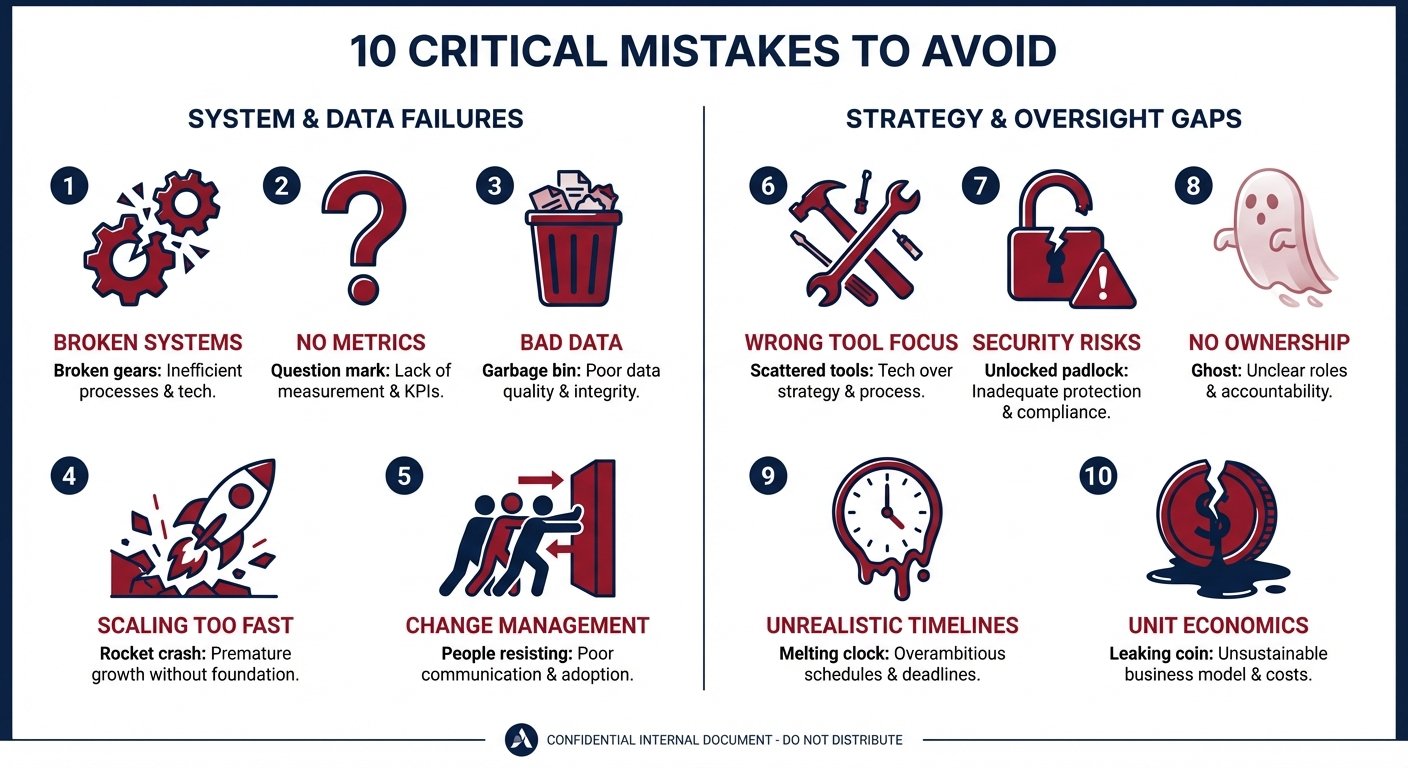
The 10 Costliest AI Adoption Mistakes (And How to Avoid Them)
70-80% of AI projects fail to meet objectives. Here are the traps that kill ROI:
1. Using AI to Avoid Fixing Broken Systems
The Mistake:
- Buying AI tools to paper over broken processes instead of fixing the underlying workflow.
Reality Check:
- If your customer handoff process is chaotic, AI will just create chaos faster. Fix the process first, then accelerate it with AI.
How to Avoid:
- Before implementing AI, map your current process. If there are more than 3 handoffs or unclear ownership, fix that first.
2. No Clear Success Metrics
The Mistake:
- "Let's try AI and see what happens" without defining what success looks like.
Reality Check:
- Enterprise buyers pay for outcomes, not intelligence. If you can't define the specific job the AI performs and what success looks like operationally, you're not ready to implement.
How to Avoid:
- Complete this sentence before buying: "This AI succeeds if it [reduces X by Y%] or [increases Z by Y%] within [timeframe]."
3. Ignoring Data Quality
The Mistake:
- Feeding AI fragmented, inconsistent, or outdated data and expecting magic.
Reality Check:
- Garbage in, garbage out—but now at AI speed. Bad data trained into AI systems becomes dangerous, not just inefficient.
How to Avoid:
- Audit your data before implementation. Ask: "Would a new employee be able to make good decisions with this information?"
4. Scaling Before Proving Value
The Mistake:
- Rolling out AI enterprise-wide before proving it works in a controlled setting.
Reality Check:
- Rushing to company-wide deployment multiplies problems exponentially and creates expensive chaos. Small failures cost hundreds; scaled failures cost millions.
How to Avoid:
- Start with one team, one use case. Prove ROI over 60-90 days. Document learnings. Then scale.
5. Underestimating Change Management
The Mistake:
- Treating AI adoption as a technology project instead of a change management challenge.
Reality Check:
- AI adoption is fundamentally a people challenge involving technology. Employee fears about job displacement, middle manager resistance, and champion burnout kill more AI projects than bad technology.
How to Avoid:
- Communicate the "why" clearly: AI handles repetitive work so humans can do higher-value tasks
- Involve skeptics early—make them testers and co-creators
- Celebrate early wins publicly
- Provide hands-on training, not just documentation
6. Choosing Tools Instead of Solving Problems
The Mistake:
- Starting with "Which AI tool should we buy?" instead of "What problem are we solving?"
Reality Check:
- Tool-first thinking leads to shiny object syndrome and fragmented toolsets. You end up with 7 AI subscriptions, none of which talk to each other.
How to Avoid:
- Start with the problem. Map your most expensive, repetitive, or error-prone process. Then find the tool that solves that specific problem.
7. Ignoring Security Until It's Too Late
The Mistake:
- Not thinking about data security, privacy, and compliance until mid-deal or post-incident.
Reality Check:
- Enterprise buyers demand answers about data processing, model usage, output governance, and liability. AI that can't pass security review becomes a deal blocker.
How to Avoid:
- Ask these questions BEFORE buying:
- Where is our data processed and stored?
- Does our data train external models?
- What happens to sensitive information?
- Are we compliant with GDPR/SOC 2/industry regulations?
8. No Ownership or Governance
The Mistake:
- Treating AI as "someone else's problem" without clear ownership.
Reality Check:
- AI without internal ownership becomes shelf-ware. Someone needs to own the strategy, monitor usage, optimize prompts, and measure results.
How to Avoid:
- Assign an "AI Champion" for each use case. Make it part of their job description with clear KPIs.
9. Unrealistic Timelines and Expectations
The Mistake:
- Expecting transformation in weeks when realistic timelines span months or quarters.
Reality Check:
- Leadership expects AI magic in 30 days. Real transformation takes 3-6 months to show measurable results in productivity, cost reduction, or customer satisfaction.
How to Avoid:
- Set realistic milestones:
- 30 days: Baseline established, tool deployed, team trained
- 60 days: Initial results measured, first optimizations made
- 90 days: ROI calculated, decision to scale or pivot
10. Not Tracking Unit Economics
The Mistake:
- Launching AI features without understanding per-unit costs.
Reality Check:
- AI costs accumulate across compute, inference, retraining, support, and exception handling. Many teams ship features before understanding unit economics, causing margins to quietly erode.
How to Avoid:
- Calculate your cost-per-output:
- AI-generated email: $0.03-0.08 each
- AI support ticket: $0.12-0.40 each
- AI video: $2-15 each
If your margin per transaction is $5 and AI costs $4, you have a problem.
Real-World Success Stories: The Numbers That Matter
Let's look at three businesses that measured AI ROI correctly and achieved measurable results.
Case Study 1: Green Thumb Landscaping (Small Business)
The Challenge:
- Manual scheduling took 4 hours per week, and late payments were at 30%.
The Solution:
- Implemented AI scheduling assistant and automated payment reminders.
Results (12 months):
- Scheduling time: 4 hours → 1 hour per week (75% reduction)
- Late payments: 30% → 10% (improved cash flow)
- Time saved: 156 hours/year × $45/hour = $7,020
- Cash flow improvement: ~$15,000 faster collections
- AI cost: $588/year
- ROI: 123%
Case Study 2: Mid-Size Law Firm (50 Attorneys)
The Challenge:
- Contract review was a bottleneck limiting case capacity.
The Solution:
- AI-assisted contract analysis and risk flagging.
Results (6 months):
- Review time per contract: 45 min → 8 min (82% faster)
- Contracts reviewed per attorney: +60% capacity
- New cases taken without hiring: 18 ($720,000 in billings)
- AI cost: $24,000/6 months
- Net value: $696,000 (2,900% ROI)
Case Study 3: E-Commerce Brand (Jordan Craig Apparel)
The Challenge:
- Email marketing was generic and underperforming.
The Solution:
- AI-powered personalized email campaigns.
Results (12 months):
- Email revenue: +54% year-over-year
- Incremental revenue: ~$380,000
- AI + implementation cost: $18,500
- ROI: 1,954%
Key Insight:
- All three businesses succeeded because they measured the
right things
- —time saved, capacity gained, and revenue generated—not vague "productivity improvements."
How to Get Found: Optimizing for AI Search and GEO
In 2026, 37% of searches now go through AI systems like ChatGPT, Perplexity, and Google AI Overviews instead of traditional search. If you want your business to be recommended when someone asks, "How do I measure AI ROI for my small business?", you need to optimize for Generative Engine Optimization (GEO).
What AI Search Engines Look For
Unlike traditional SEO which ranks pages, AI search synthesizes answers from multiple sources and cites only 2-7 domains per response. To be cited, your content must:
- Answer questions directly – Put clear answers in the first 5 lines of each section
- Use question-shaped headers – "How to measure AI ROI" not "AI ROI measurement"
- Include proof next to claims – Statistics, case studies, specific numbers
- Provide structured data – Tables, lists, step-by-step frameworks
- Cite authoritative sources – Link to research, case studies, and reputable data
The 3 Content Types AI Engines Prioritize
1. How-to guides
- (like this article) – Step-by-step frameworks with clear outcomes
2. Comparison content
- – "X vs Y", "Top 10 tools", "Which option for [scenario]"
3. Problem-solution
- – Address specific pain points with actionable solutions
Example:
Traditional SEO thinking: "AI ROI Measurement Strategies" GEO thinking: "How to Measure AI ROI: 5 Metrics Every Business Owner Should Track"
The second version matches how humans ask AI systems questions.
Building Your AI Measurement System with DIMA
Most businesses fail at AI measurement because they're using disconnected tools that don't talk to each other. You can't measure what you can't see.
DIMA solves this with unified visibility:
Built-in ROI Tracking
Every agent action is logged with:
- Time spent on task
- Tokens consumed (cost)
- Output quality scores
- Human intervention required
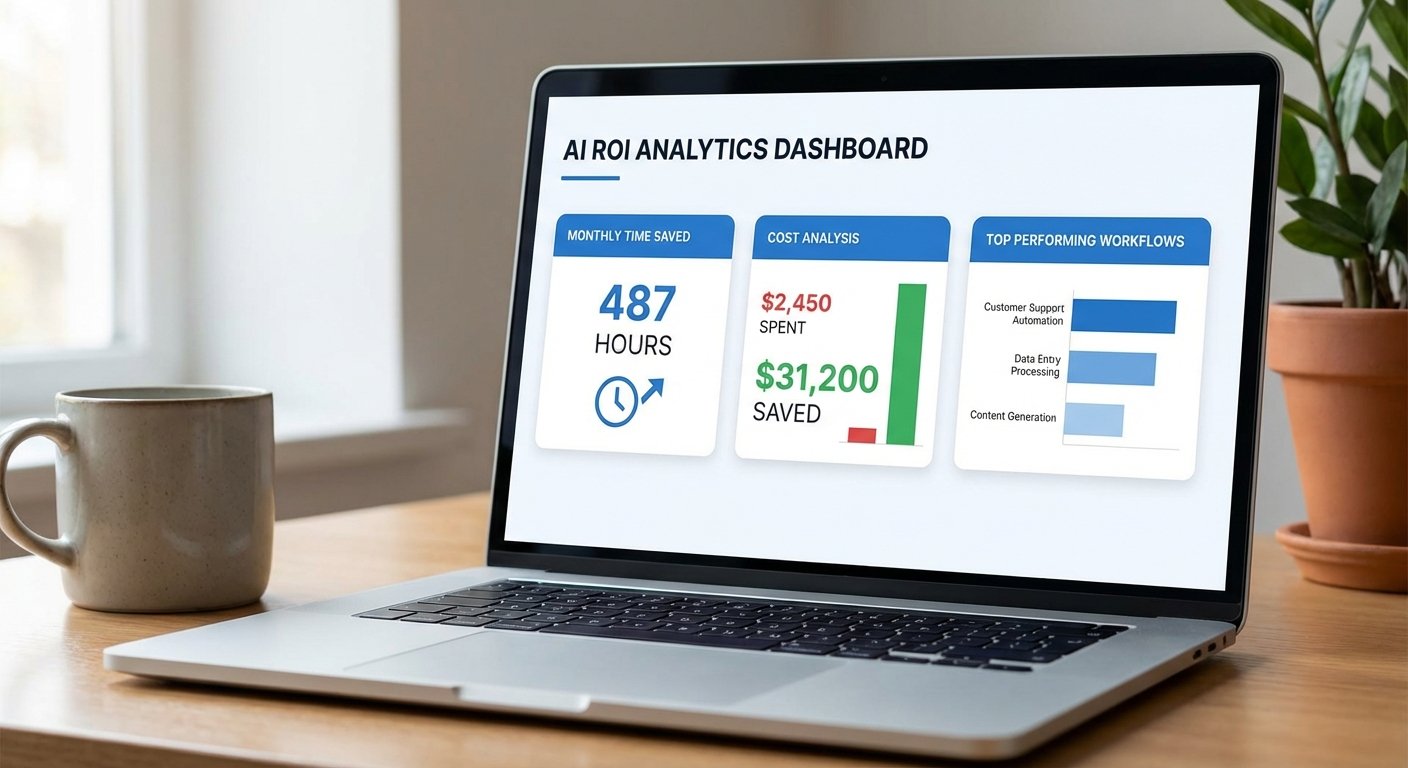
Real-Time Dashboards
See your AI ROI metrics in one place:
- Total time saved across all workflows
- Cost per task (and cost trends)
- Capacity gains by department
- Error reduction rates
Automated Reporting
Monthly AI value reports delivered to your inbox showing:
- Net benefit vs. cost
- ROI by use case
- Recommendations for optimization
Why it matters:
- You can't optimize what you don't measure. DIMA gives you the visibility to prove value, optimize workflows, and scale confidently.
Conclusion: Measurement is Strategy
Here's the truth about AI ROI: If you can't measure it, you can't manage it. And if you can't manage it, it won't deliver value.
The companies winning with AI in 2026 aren't the ones with the most powerful models or the biggest budgets. They're the ones who:
- Start small with one measurable use case
- Establish baselines before implementation
- Track the right metrics (time, errors, capacity, revenue, quality)
- Calculate true costs including hidden expenses
- Optimize continuously based on data
- Scale only after proving value
Most businesses are guessing. You don't have to be.
Ready to measure AI value the right way?
- Explore DIMA's AI ROI tracking tools and start proving impact within 30 days.
FAQ: Common Questions About AI ROI Measurement
Q: How long should I wait before measuring AI ROI?
A: Start tracking from day one, but wait 30-60 days before making major decisions. Early results can be misleading as teams learn the tools.
Q: What's a "good" AI ROI percentage?
A: For most businesses, anything above 200% annual ROI is strong. Time-saving use cases often deliver 300-800% ROI. Revenue-generating use cases can exceed 1,000% but take longer to materialize.
Q: Should I measure ROI by tool or by use case?
A: By use case. A single tool might deliver 900% ROI for customer support but negative ROI for content creation. Measure where and how you use AI, not just what you buy.
Q: What if my AI ROI is negative after 90 days?
A: First, verify you're measuring correctly (are you including all benefits?). If truly negative, identify the bottleneck: wrong tool, bad training, poor use case fit, or unrealistic expectations. Either fix it or kill the project—don't throw good money after bad.
Q: How do I prove "soft" benefits like employee satisfaction?
A: Use proxy metrics: employee retention rates, time-to-hire for backfill positions, sick days, and productivity survey scores. If AI improves morale, you'll see it in reduced turnover and recruitment costs.
Q: Can I measure AI ROI if I'm using free tools?
A: Yes! Even free tools have costs: setup time, training time, opportunity cost. Measure the time savings and capacity gains. The formula still works.
 DIMA
DIMA