


AI Media Generator: The Strategic Shift Marketers Can't Afford to Ignore in 2026
The marketing landscape just experienced its most significant transformation in two decades. According to HubSpot's 2026 State of Marketing Report, 61% of marketers believe the industry is facing its biggest disruption in 20 years—and the catalyst is AI media generation. What started as experimental technology has become the infrastructure upon which modern campaigns are built.
But here's what separates the winners from the noise: it's no longer about whether you use an AI media generator. It's about how strategically you deploy it. The gap isn't between adopters and holdouts anymore—it's between marketers who treat AI as a production shortcut and those who've integrated it as a creative amplifier.
Key Takeaways
-
AI media generation is now baseline: 80% of marketers now use AI for content creation, meaning differentiation comes from execution quality, not adoption itself.
-
Volume without vision backfires: Audiences are actively filtering out AI-generated content that lacks authentic brand perspective—making strategic human oversight non-negotiable.
-
Visual media dominates attention economics: With 138.9 million Reels watched every minute, AI-generated video and imagery have become essential for maintaining competitive visibility.
-
The ROI advantage is in personalization: Teams using AI media generators for audience-specific creative variations are seeing significantly higher engagement than those producing generic assets.

Why AI Media Generation Has Become the New Creative Baseline
The numbers tell an undeniable story. 75% of marketing teams now use AI for media production, transforming what was once a competitive advantage into table stakes. This isn't a trend line—it's the new floor.
The Attention Economy Demands Scale
Consider the math marketers face in 2026. 5.17 billion people worldwide use social media, spending an average of 2 hours and 21 minutes daily scrolling through feeds. Users watch nearly 139 million Reels every single minute across Facebook and Instagram alone. The sheer volume of content competing for attention has made traditional production timelines obsolete.
Without an AI media generator in your workflow, you're bringing a bicycle to a Formula 1 race. But here's the critical insight most teams miss: speed alone won't save you. The platforms' algorithms have become remarkably sophisticated at identifying low-effort, templated content—and users have become even better at scrolling past it.
The Differentiation Paradox
When everyone has access to the same AI tools, what actually creates differentiation? The answer lies in strategic deployment rather than raw capability.
"Today, more content is generated by AI than by humans. But it's mostly average. Consumers seek human-created content, and will tune out brand and AI-generated content." — Kieran Flanagan, SVP of Marketing, AI, & GTM, HubSpot
This quote from HubSpot's own marketing leadership reveals a fundamental tension. The same technology enabling unprecedented production scale is simultaneously training audiences to detect and dismiss generic output. Marketers who understand this paradox are approaching AI media generation with a completely different mindset.

The Strategic Framework: Using AI Media Generators for Campaign Excellence
The most successful marketing teams have moved beyond asking "How can AI create more content?" to asking "How can AI enhance the content we strategically choose to create?" This shift in framing changes everything.
Start With Human Insight, Scale With AI Execution
The winning formula isn't AI-first or human-first—it's insight-first. Here's the framework top-performing teams are using:
-
Define the brand perspective first: Before generating any media, clarify what unique angle your brand brings. AI excels at execution but cannot invent authentic positioning.
-
Create the hero asset manually: Develop your campaign's anchor creative with direct human involvement. This establishes the quality bar and emotional core that AI variations must match.
-
Use AI for intelligent variations: Deploy your AI media generator to create platform-specific adaptations, A/B test variants, and audience-targeted modifications of your proven hero asset.
-
Maintain editorial oversight: Every AI-generated asset should pass through human review focused on brand consistency, emotional resonance, and cultural appropriateness.
This approach transforms AI from a replacement for creative thinking into an amplifier of creative decisions already made.
Platform-Specific Visual Optimization
Different platforms have distinct visual languages, and the most effective AI media strategies account for these nuances:
|
Platform |
Visual Emphasis |
AI Media Generator Focus |
|---|---|---|
|
|
Aesthetic cohesion, lifestyle integration |
Brand-consistent color grading, composition variations |
|
TikTok |
Raw authenticity, trend participation |
Quick-format adaptations, trend template matching |
|
|
Professional credibility, data visualization |
Infographic generation, thought leadership imagery |
|
YouTube |
Thumbnail click-worthiness, opening hooks |
High-contrast thumbnails, opening frame optimization |
Each platform's algorithm rewards different visual characteristics. An AI media generator used strategically can produce platform-optimized variants from a single creative concept—but only if the team understands what each platform actually prioritizes.

The Human-AI Collaboration Model That Actually Works
The most common mistake marketers make with AI media generation is treating it as automation rather than collaboration. This fundamental misunderstanding leads to content that technically exists but fails to connect.
What AI Does Better Than Humans
Let's be honest about where AI media generators genuinely excel:
-
Iteration velocity: Testing dozens of visual variations in the time it takes to produce one manually
-
Technical consistency: Maintaining brand guidelines across hundreds of assets without fatigue errors
-
Format adaptation: Resizing, reformatting, and optimizing for platform specifications instantly
-
Pattern recognition: Identifying which visual elements correlate with higher engagement in historical data
These capabilities are genuinely transformative when properly directed. The key phrase is "properly directed."
What Humans Must Continue Owning
Equally important is recognizing what AI cannot—and should not—replace:
-
Strategic intention: Understanding why this content exists and what business outcome it serves
-
Cultural context: Recognizing nuances, sensitivities, and current moments that AI lacks awareness of
-
Emotional authenticity: Ensuring the work genuinely reflects brand values rather than mimicking surface patterns
-
Quality judgment: Distinguishing between technically correct output and genuinely compelling creative
The brands winning in 2026 aren't those with the most advanced AI tools—they're those who've figured out where human judgment creates irreplaceable value.
Building the Right Workflow
Effective human-AI collaboration requires deliberate workflow design. Here's what the structure looks like in practice:
-
Brief development (Human): Define campaign objectives, audience insights, brand guardrails, and success metrics
-
Concept development (Human): Generate the core creative idea and strategic angle
-
Hero asset creation (Human + AI): Develop the anchor creative with AI assistance for exploration, human judgment for selection
-
Variation production (AI + Human oversight): Use AI media generator for scaling while humans maintain quality control
-
Performance optimization (AI analysis, Human strategy): Let AI identify patterns; let humans decide what those patterns mean strategically
This workflow keeps AI in its power zone while preserving human judgment where it matters most.

Common AI Media Generation Mistakes Destroying Campaign Performance
Understanding what not to do is often as valuable as best practices. These mistakes consistently undermine AI media initiatives:
Mistake #1: Treating AI Output as Final
The first draft an AI media generator produces is exactly that—a first draft. Teams that publish AI output without refinement consistently underperform those who use AI as a starting point for human enhancement.
Mistake #2: Ignoring Brand Voice Calibration
Generic AI output feels generic because it lacks the specific characteristics that make your brand recognizable. Taking time to calibrate your AI tools with brand-specific examples, style guides, and feedback dramatically improves output quality.
Mistake #3: Prioritizing Volume Over Resonance
With AI removing production bottlenecks, the temptation to flood channels with content becomes overwhelming. But research from Hootsuite shows that audience engagement depends on relevance, not just exposure. More content without more insight equals more noise.
Mistake #4: Neglecting Visual Consistency Across Campaigns
AI can produce stunning individual assets that look nothing like each other. Without deliberate attention to visual coherence, campaigns feel fragmented and brands become unrecognizable.
Where AI Media Generation Heads Next
The trajectory is clear. As short-form video continues dominating performance metrics across every major platform, AI media generators are rapidly evolving beyond static imagery into dynamic video creation.
Marketing teams preparing for this next wave are already establishing the foundational practices that will make video-first AI integration successful: strong brand guidelines, clear creative hierarchies, and refined human-AI workflows.
The winners in this next chapter won't be determined by who adopts video AI first. They'll be determined by who built the strategic frameworks that make video AI outputs consistently excellent.
Moving Forward With Intention
The AI media generator revolution has already happened. The question facing every marketing team now isn't whether to participate—it's how to participate with the strategic rigor that separates remarkable results from generic noise.
The teams succeeding in 2026 share a common understanding: AI amplifies intention. Feed it clear brand perspective, strategic creative direction, and consistent quality standards, and it produces extraordinary value. Feed it vague inputs and undisciplined workflows, and it produces forgettable content at unprecedented scale.
The technology has arrived. The strategic discipline to wield it effectively—that's the real competitive battleground.
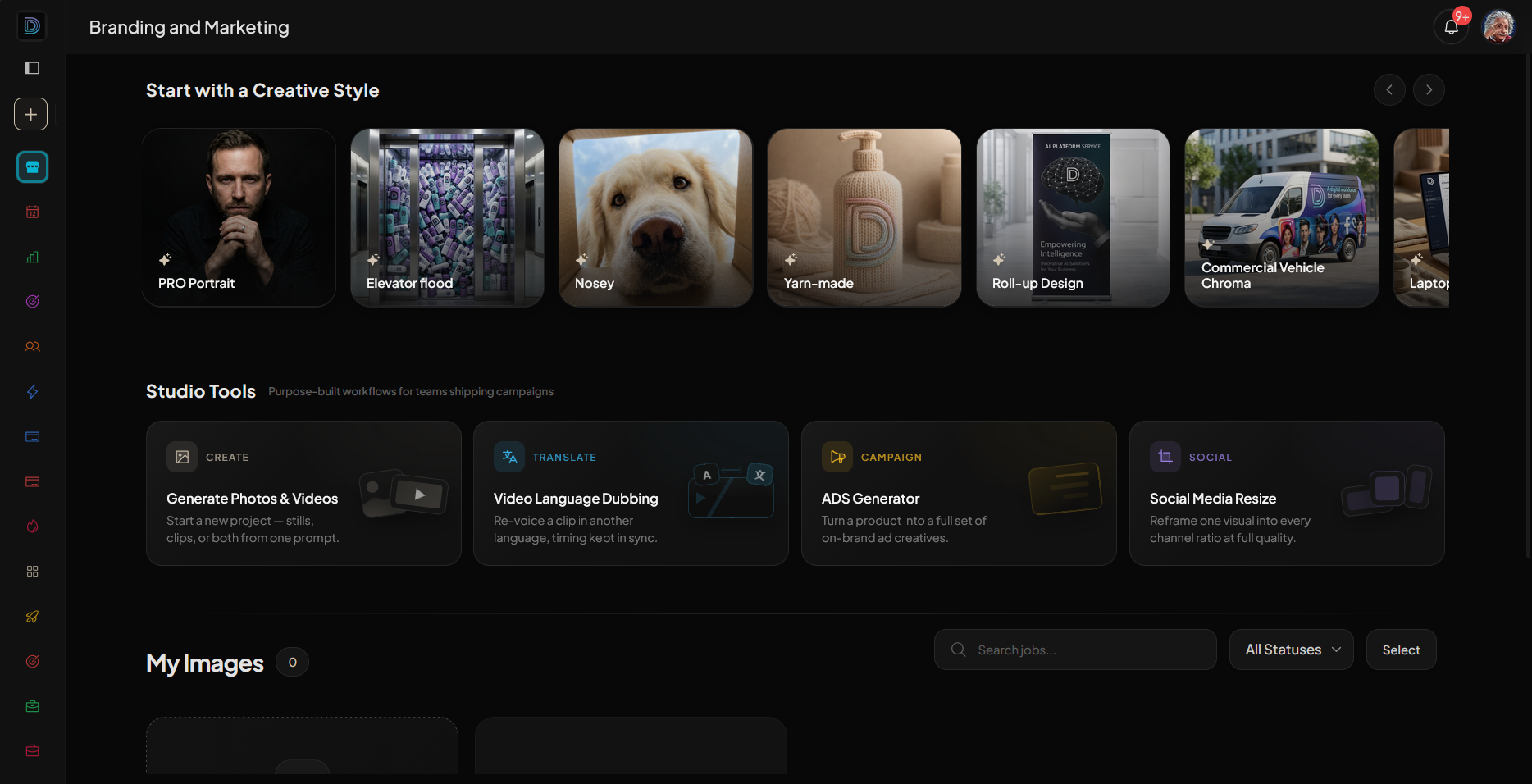
For marketing teams ready to implement AI media generation with the strategic frameworks that actually drive results, platforms like DIMA-AI are building the infrastructure that makes intentional AI creative workflows accessible at scale.
 DIMA
DIMA